






I-94 is one of the busiest commercial corridors in the upper Midwest. It carries freight east and west across North Dakota, Minnesota, and beyond, and on any given day a stretch of it has 18-wheelers running flat at posted speed in heavy crosswinds, winter weather, or summer construction. When something goes wrong on that highway, the way the driver handles the first 30 minutes often determines how the rest of the recovery goes.
This guide walks 18-wheeler drivers and fleet dispatchers through what to do when a semi goes down on I-94, before the tow truck arrives. It is written for the realities of a heavy commercial breakdown, not a passenger car on the shoulder.
1. Get the Truck Off the Travel Lane If You Possibly Can
If the truck still rolls under its own power, get it as far onto the shoulder as the rig will allow. The right shoulder is preferred. If you have any choice, aim for a wide spot, an off-ramp, a rest area, or a truck pullout. The difference between a partially blocked travel lane and a clean shoulder is the difference between a routine 18 wheeler towing call and a multi-agency scene closure with traffic control involved.
If the truck will not move, do not try to roll it on a flat or a failed wheel end. You will damage more components and complicate the recovery. Stay where you are and start the next steps.
2. Set Up Warning Devices
Federal regulations require commercial drivers to set out warning devices when stopped on a highway. For a truck on I-94, that typically means three reflective triangles:
- One within 10 feet of the rear of the truck
- One about 100 feet behind the truck
- One about 200 feet behind the truck on the same side of the road
If you’re stopped on a divided highway with traffic only behind you, that pattern is straightforward. If the truck is in a curve, on a hill, or near limited visibility, place the warning devices farther back. In active snow, blowing dust, or fog, hazard lights alone are not enough.
This is not just a paperwork issue. A heavy wrecker will need to safely approach and stage equipment, and visible warning devices give them a workable scene.
3. Stay With the Truck and Stay Safe
Unless there’s an immediate hazard like a fire, fuel leak, or load that’s actively shifting, the safest place is generally inside the cab with your seatbelt on. Trucks parked on the shoulder of I-94 get hit. If you must exit the cab, exit on the passenger side, away from the travel lane, and stand behind the guardrail or well off the shoulder.
Do not stand between your truck and another vehicle, and do not try to inspect a wheel end or undercarriage while traffic is passing at 70-plus.
4. Make the Right Calls in the Right Order
Order matters. A quick reference:
- 911 if there is any safety issue. Injury, fire, leaking fluids, blocked travel lane, or an active hazard goes to law enforcement first.
- Your dispatcher or fleet manager. They need to know the load is delayed, and they likely have a preferred carrier or a standing fleet account for 18 wheeler towing.
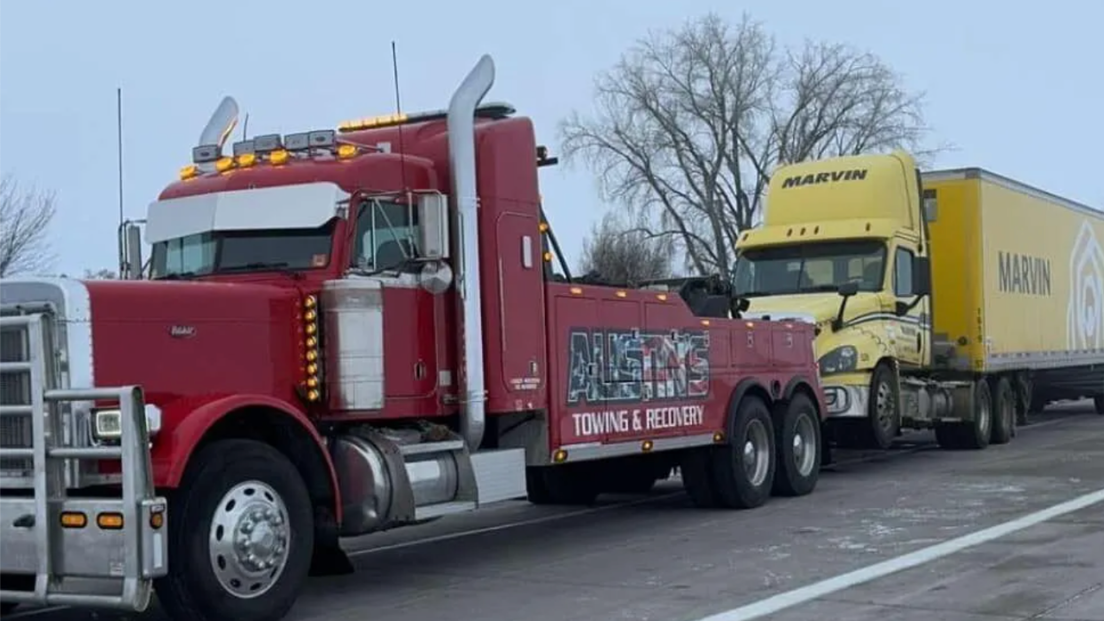
- A heavy-duty tow company. If you don’t have a fleet vendor for this corridor, Austin’s Towing & Recovery dispatches heavy-duty wreckers along I-94 across North Dakota and into Minnesota and South Dakota. Call (701) 388-3198 24/7.
- The shipper or consignee if the delay will affect delivery.
5. Pin Your Location Precisely
“Somewhere east of Fargo on I-94” is not enough information for a heavy-duty wrecker to find you efficiently. Before you call dispatch, pull up your exact location. The information that matters most:
- Mile marker
- Direction of travel (eastbound or westbound)
- Side of road (right shoulder, left shoulder, in the median)
- Nearest exit or town
- A landmark if there’s one visible
If you have your phone, dropping a pin in a maps app and reading the coordinates to dispatch is faster and more reliable than a verbal landmark.
6. Gather the Information the Tow Operator Will Need
While you wait, prep the details a heavy-duty dispatcher will ask for so the first call is the last call. Have ready:
- Truck make, model, year, and combined weight
- Tractor and trailer condition (rolling, disabled, accident)
- Trailer type (dry van, reefer, flatbed, tanker)
- Cargo type and approximate weight
- Whether the load is hazardous, perishable, or oversize
- Whether the rig is hooked or dropped from the trailer
- Insurance and carrier information
- Destination for the tow (repair shop, terminal, yard)
This list is what separates a clean 18 wheeler towing job from one that needs a second dispatch because the first wrecker showed up to a scene it wasn’t equipped for.
7. Document the Scene
A few quick photos protect you and the carrier. Cover:
- The truck in its stopped position, including the shoulder placement
- Any damage to the rig
- The trailer and any visible cargo issue
- Surrounding road conditions, weather, and warning devices
- Mile marker signs and exit signs
Insurance carriers and fleet risk teams use these. Send them to your dispatcher when you can.
8. Don’t Accept Help From Unsolicited Tow Trucks
If a wrecker shows up unbidden, especially after a high-profile crash, be careful. The Fargo-Moorhead area has good, professional heavy operators, but accident-chaser problems exist on every busy interstate corridor. Verify the truck and the operator match the company your dispatcher hired before you authorize anything.
If you want help vetting an operator in advance, here’s how to choose a reliable semi tow truck business. If you didn’t make the call, don’t sign for the tow.
9. Coordinate the Handoff With the Driver
When the heavy-duty wrecker arrives, the operator runs the scene from a towing perspective. Stay in the cab if directed, follow the operator’s lead on hookup, and confirm where the truck and trailer are being towed. Make sure the operator has your contact info and your dispatcher’s contact info before you leave the scene.
Heavy-Duty 18 Wheeler Towing Along I-94, 24/7
Austin’s Towing & Recovery dispatches heavy-duty wreckers from West Fargo across the I-94, I-29, and US-2 corridors, covering breakdowns, accidents, and recoveries for 18-wheelers, tractor-trailers, and big rigs across ND, MN, and SD.
If you’re down on I-94 or anywhere in the region, call (701) 388-3198 any time. A live dispatcher will route the right truck to your exact location.