







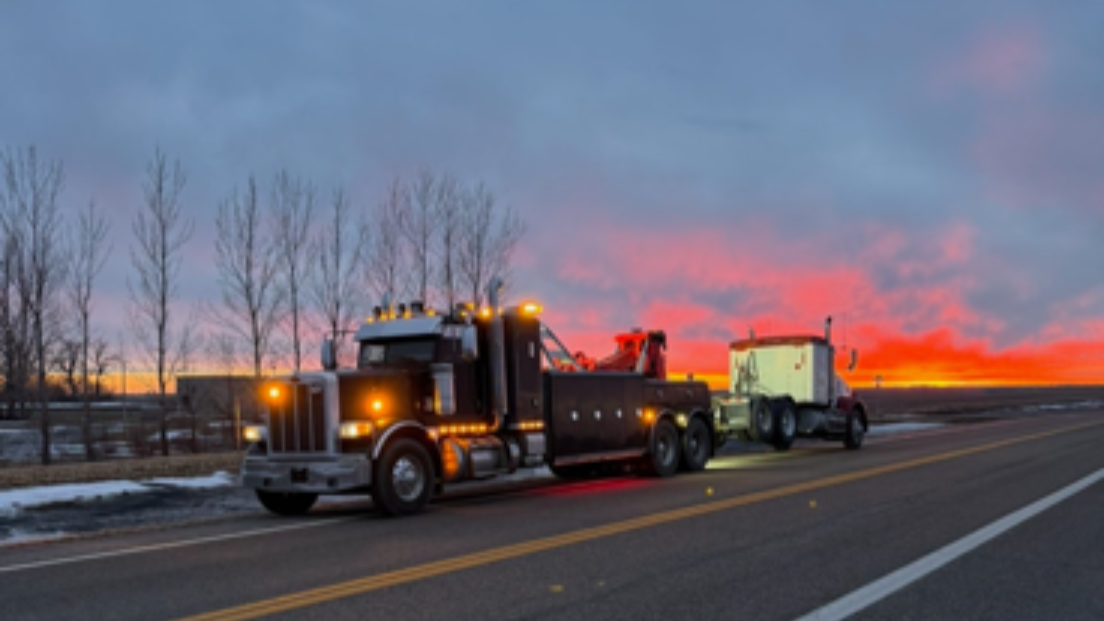
A semi-truck breakdown 30 miles from your terminal is one kind of problem. A semi-truck breakdown 400 miles from your terminal is a different one entirely. Long-distance truck towing involves cross-state logistics, fueling and rest stops for the wrecker, coordination with the carrier and the load owner, and a recovery plan that often spans a full day or more. If you operate commercial vehicles through the upper Midwest, knowing how a long-haul recovery actually works is the difference between an organized handoff and a chaotic phone tree.
This post walks through what long-distance semi towing looks like along the I-94, I-29, and US-2 corridors that run through North Dakota, Minnesota, and South Dakota. It is written for fleet managers, owner-operators, dispatchers, and anyone who has to decide where to send a disabled truck that’s a long way from home.
The Three Major Corridors
Most long-distance truck towing in this region happens along one of three interstates and federal highways:
- I-94 runs east-west across central North Dakota through Fargo, Jamestown, Bismarck, and Dickinson, connecting to Minneapolis-Saint Paul to the east and Billings to the west.
- I-29 runs north-south through Fargo, Grand Forks, and into Manitoba to the north, and south through Sioux Falls, Omaha, and Kansas City.
- US-2 crosses northern North Dakota through Grand Forks, Devils Lake, Minot, and Williston, the artery for traffic into and out of the Bakken oil region.
These corridors carry serious commercial volume. A heavy-duty operator working long-distance semi towing in this region builds the route into the dispatch decision: which wrecker is closest, where the next staging point is, where fuel and operator rest will happen, and how the handoff to the destination shop or terminal works.
When You Need Long-Distance Truck Towing
A few common scenarios drive the request:
- Mechanical failure far from a fleet’s preferred repair shop. The carrier wants the truck and trailer brought back to their network rather than dropped at the closest unfamiliar facility.
- Accident recovery with cargo intact. The cargo needs to continue, and the disabled tractor needs to come home for repair or write-off.
- Repositioning a disabled rig from a temporary impound or storage yard. A truck that was towed off a scene days or weeks earlier needs to be moved back to home base.
- Cross-state warranty work. A new tractor under OEM warranty needs to be returned to a specific dealer that may be several states away.
- Owner-operator preference. The driver and the carrier both want the equipment serviced where they know the shop and the mechanics.
In each scenario the towing operator becomes part of a longer logistics chain, not just a single recovery call.
What a Long-Haul Recovery Day Looks Like
Long-distance truck towing is rarely a fast process. Here is a realistic anatomy of a long-haul recovery along the I-94, I-29, or US-2 corridors.
Hour 0 to 1: Call, Dispatch, and Scope
The carrier or driver calls a heavy-duty operator. Dispatch confirms the vehicle, the load, the breakdown scenario, and the destination. A heavy-duty wrecker is assigned. If the recovery is straightforward (the truck is on the shoulder, undamaged, with a known destination), the call is scoped quickly and the wrecker is on the road. If there’s accident damage, cargo issues, or insurance authorization needed, this step can take longer.
Hour 1 to 6: Drive Time to Scene
Heavy-duty wreckers run at posted speeds. A unit dispatched from West Fargo can reach most of central North Dakota or western Minnesota within a few hours. Reaching western North Dakota, central South Dakota, or the eastern edges of Montana can be a half-day drive each way. Weather, road conditions, and any active road closures factor in.
On Scene: Recovery and Securement
Once on scene, the operator assesses the truck and trailer, addresses any pre-tow recovery needs (winching the truck out of a position, securing damaged components, transferring cargo if necessary), and rigs the tow for long-haul transport. For a long-distance pull, securement matters more than on a short tow. A truck that’s going to be on a wrecker for 6 to 10 hours of highway travel has to be rigged so it stays put.
Transport: Return Leg
The wrecker now hauls the truck and trailer (or just the tractor, depending on the configuration) back to the destination. On long pulls, the operator may need a scheduled fuel stop and federally required rest. A 500-mile return leg is not a single uninterrupted drive at heavy-duty wrecker speeds.
Delivery and Handoff
The truck is delivered to the carrier’s chosen destination: a fleet terminal, a repair shop, a dealership, or a yard. The operator confirms delivery with the dispatcher who hired the tow, exchanges paperwork, and closes the call.
For a long-distance recovery across one of the three major corridors, total elapsed time from call to delivery often runs 12 to 24 hours, sometimes longer for the most extended jobs.
What Carriers and Fleet Managers Should Ask Up Front
A few questions to ask before authorizing a long-distance truck towing job:
- What is the all-in estimate? Long-haul recoveries are priced based on equipment, hookup, miles, and scene complexity. Get an honest estimate – See our heavy-duty towing cost guide
- Who is the operator and what is their authority and insurance posture? Cross-state moves require proper motor carrier authority and cargo coverage that matches your load.
- What is the realistic ETA to scene, and to the destination? Plan delivery, terminal staffing, and shop appointments around real numbers, not optimistic ones.
- What is the contingency if weather or road closures interrupt the route? A professional operator has an answer.
- Are you set up for fleet billing? Long-haul recoveries are typically not a one-time event for active carriers. A fleet account speeds the next call.
Austin’s Towing & Recovery on the Long-Haul Corridors
Austin’s Towing & Recovery is based in West Fargo, ND, on the intersection of I-94 and I-29, with regular dispatch into the US-2 corridor. The location makes the company a practical staging point for long-distance semi towing across the upper Midwest. Heavy-duty wreckers, trained operators, and 24/7 dispatch are all set up for the realities of a long-haul recovery rather than a quick shoulder tow.
If you operate fleets through North Dakota, Minnesota, or South Dakota, a standing relationship with a heavy-duty operator in the region shortens the response on every call. Ask about fleet account setup so the next long-distance tow is one call rather than a vendor search at 3 a.m.
Need Long-Distance Truck Towing Across I-94, I-29, or US-2?
Call Austin’s Towing & Recovery 24/7 at (701) 388-3198. Heavy-duty wreckers ready for long-haul recoveries across ND, MN, and SD.